| T O P I C R E V I E W |
| nicky |
Posted - 17/10/2025 : 16:04:15
Trusmadi, Sabah, Malaysia

https://www.flickr.com/photos/nickadel/54824137058

https://www.flickr.com/photos/nickadel/54823866591 |
| 7 L A T E S T R E P L I E S (Newest First) |
| Xavier |
Posted - 14/11/2026 : 19:18:02
Your specimen’s third antennal segment is longer than the fourth, which defines the subgenus Desisa (Cylindrostyrax) Aurivillius, 1911. I am not certain of the identification as the successive descriptions are imprecise (Pascoe 1885, Aurivillius 1911 & 1913, Breuning 1963).
I am attaching Pascoe’s original description and the illustration published by Aurivillius (1913):
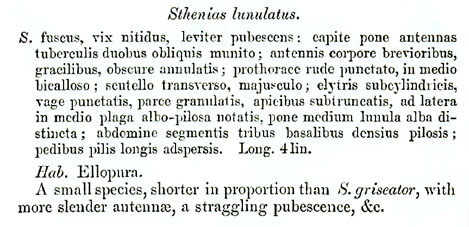
67.3 KB
Pascoe 1885
Pascoe’s text makes it clear that " prothorax coarsely punctate, bicallose in the middle "
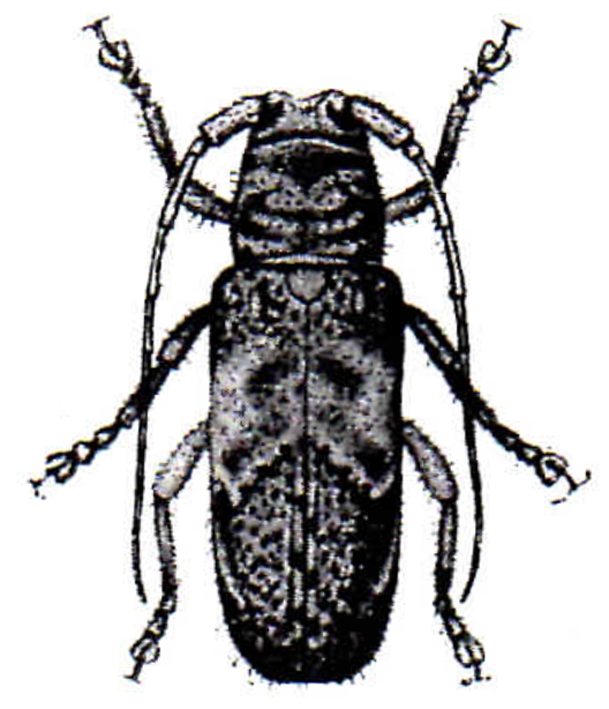
206.61 KB
Aurivillius 1913
Desisa (Cylindrostyrax) lunulata (Pascoe, 1885) |
| loongfah |
Posted - 14/11/2026 : 14:33:33
I examined my Singapore specimen (https://www.cerambycoidea.com/forum/topic.asp?TOPIC_ID=19111) under scope and found that the eyes are not divided, so it is not a Pterolophia.
It seems (although it is not very clear from the image) that this Sabah species also does not have divided eyes.
Xavier, I thought your original identification of Desisa lunulata might be the correct one?
|
| loongfah |
Posted - 27/10/2026 : 13:15:20
Thanks a lot, Xavier! |
| Xavier |
Posted - 27/10/2026 : 10:01:04
Pterolophia laterialbipennis Breuning, 1964 (translation)
Elongated body. Antennae as long as the body; the third segment slightly longer than the fourth and much longer than the first. Lower ocular lobes transverse, slightly longer than the cheeks. Head and pronotum densely and very finely punctate. Pronotal disc bearing several faintly marked obtuse tubercles. Elytra long, convex, rounded at the apex, finely granular at the base, then densely and rather coarsely punctate, with the punctation becoming finer toward the apex. Legs robust; femora and tibiae covered with short, erect hairs.
Red to reddish-brown tomentose hair. On each elytron, a broad, yellowish-white premidial transverse band, sloping obliquely toward the lateral margin, much more densely tomentose in its lateral half, and bordered at the posterior margin by a zigzagging transverse line, also densely tomentose. Posterior femora and tibiae are densely tomentose, white, and covered with erect white hairs. Posterior tarsi are finely tomentose, whitish gray. Length: 9 mm; Width: 3 mm. Type from Sumatra: Indragiri. |
| loongfah |
Posted - 27/10/2026 : 05:11:21
Could be Pterolophia laterialbipennis Breuning, 1964 described from Sumatra. I also recorded this in Singapore here.
Anyone with this Breuning paper? |
| Xavier |
Posted - 26/10/2026 : 11:26:20
More likely a Pterolophia sp., close to Pterolophia circulata Schwarzer, 1931 described from Java ?
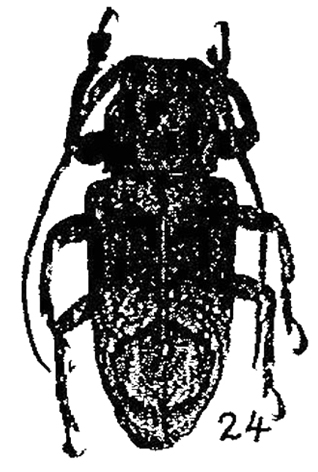
103.48 KB
Pterolophia circulata Schwarzer, 1931 HT female. |
| Xavier |
Posted - 18/10/2025 : 13:22:28
It seems to be Desisa (Cylindrostyrax) lunulata (Pascoe, 1885). |
|
|